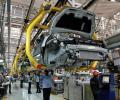
Automobile retail sales in India rose 6 per cent to 2,61,43,943 units in FY25 with rural areas performing better than urban regions across passenger vehicle and two-wheeler segments, dealers' body FADA said on Monday. The last financial year saw growth in sales of passenger vehicles, two-wheelers and three-wheelers.

A year after a Hamas attack against Israel on October 7 and the ensuing Israeli invasion of the Gaza Strip, India's trade with most West Asian countries has largely escaped any major disruption, except with countries like Israel, Lebanon, and Jordan. However, repeated flare-ups of geopolitical tensions in the region continue to drive up shipping and logistics costs.

Closely watched by the world for any escalation, the Iran-Israel conflict is already showing early signs of stress for India Inc - longer deliveries, doubling freight rates, extended working capital cycles, and higher costs. For those yet to feel the heat, there is growing apprehension and nervousness over future developments, observed industry executives.

Passenger vehicle retail sales in India witnessed a 10 per cent on-year jump in July driven by new model launches and enhanced discounts, industry body FADA said on Monday. Total passenger vehicle retail sales rose to 3,20,129 units in July, as compared to 2,90,564 units in July 2023. "Dealers reported benefits from good product availability, attractive schemes, and a wider range of products," the Federation of Automobile Dealers Associations (FADA) vice president C S Vigneshwar said in a statement.

Most of India's oil supplies are expected to stay safe because of the country's good relations with both Russia and Iran. That would take care of over a third of India's supplies.

India, the world's third largest oil consuming and importing nation, bought crude oil worth 49 billion euros from Russia in the third year of Moscow's invasion of Ukraine, a global think tank said. India, which has traditionally sourced its oil from the Middle East, began importing a large volume of oil from Russia soon after the invasion of Ukraine in February 2022.

FMCG, automobile industries say if GST regime kicks in, rail hubs can take Make in India to a new high.

'Instead of ACs, the government should do something to increase our salary.'
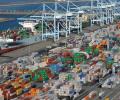
After remaining in the positive zone for three months, India's exports contracted 1.2 per cent to $33.98 billion in July, while the trade deficit widened to $23.5 billion.


India's merchandise exports dipped marginally in March to $41.69 billion, and by 3.11 per cent during the last fiscal year to $437.06 billion mainly due to continued geopolitical turmoil, and depressed global trade. Imports, too, declined in March as well during the entire 2023-24. Trade deficit, or the gap between imports and exports, narrowed 17.74 per cent in March to $15.6 billion and came down 9.33 per cent to $240.17 billion in FY24.
Exporters on Thursday sought a fund of Rs 750 crore for three years to tap USD 25 billion export potential in the US, aiming to seize potential opportunities that may arise as the US President-elect, Donald Trump, has threatened to impose high tariffs on Chinese goods. In its pre-Budget meeting with the finance ministry, Federation of Indian Export Organisations (FIEO) President Ashwani Kumar has also demanded extension of the five per cent Interest Equalisation Scheme (IES).

As a model of transport, the A380 strikes a parallel -- a shared fragility -- with giant container ships, observes Shyam G Menon.

India's manufacturing sector growth fell to a joint 11-month low of 56.5 in November, restricted by competitive conditions and inflationary pressures amid a softer increase in factory orders, a monthly survey said on Monday. The seasonally adjusted HSBC India Manufacturing Purchasing Managers' Index (PMI) fell from 57.5 in October to 56.5 in November, signalling a softer improvement in the health of the sector. However, the pace of growth remained above its long-run average.

'If attacks escalate, there is a risk the Suez Canal may be closed.'

The automobile sector is considered a good indicator of economic health. It has a very long value chain, from primary materials, like metals, glass and plastic, to value-added high-end electronic components, specialised alloys, and software.

'In April, we saw a 10 per cent growth in our own volumes.'

'The coronavirus impact is much bigger than what the market had predicted. We are helpless and simply watching the market at present. Nothing can be done,' said Anil Devli, chief executive officer (CEO) of Indian National Shipowners' Association (INSA).


'When people have money in their hands, they make their judgment about whether they want to spend it entirely or spend some out of it.'

Apple and its vendors are aiming to assemble 32 per cent of iPhone's global production volume and 26 per cent of its value in India by 2026-27 -a year after the final year of the five-year production-linked incentive (PLI) scheme for mobile devices. This could translate into a production value of over $34 billion, assuming global iPhone sales remain consistent with 2023-24 (FY24) levels. The estimates are based on discussions between Apple Inc and its vendors, along with central and state governments, regarding the assembly of products in India, according to sources.

The stock of the country's largest plastic pipe maker Supreme Industries has shed 22 per cent since its highs in October. The September quarter results were below expectations as the volatility in polyvinyl chloride (PVC) resin prices led to a major destocking across the trade channel.

Any government support or incentive to help exporters deal with high freight and insurance costs is unlikely.
Amidst cyclical downtrend, the shipping sector seeks the government to create a shipping fund with an initial allocation of Rs 10000 crore for acquisition of ships.

Freight rates for grains, pulses and urea would increase by 10%.

India's manufacturing sector saw a slower growth rate for the second straight month in May but stayed firmly in expansion mode with global sales increasing to the greatest extent in over 13 years, a monthly survey said on Monday. The seasonally adjusted HSBC India Manufacturing Purchasing Managers' Index (PMI) fell from 58.8 in April to 57.5 in May, signalling a slower but substantial improvement in the health of the sector. The index had climbed to a 16-year high of 59.1 in March.

The NSE Nifty closed at 4861, lower by eight points. The mid-cap and small-cap indices ended marginally lower.
The congestion at Australia's Newcastle Port is bringing cheers to Indian shipping companies.

While this benefit of easing fuel cost should have been passed on to consumers through the review of FAC due this month, the Railways does not intend to revise freight and passenger fares until the next Budget to be presented in February.

What makes Pushpa 2 float is Allu Arjun's magnetic performance. The actor really goes an extra mile to deliver the wildfire he promised, observes Mayur Sanap.
Highlights of the Railway Budget 2004-2005 presented by the Union Minister of Railways Lalu Prasad Yadav in the Lok Sabha on Tuesday.
The year 2004 has been pretty volatile for the global shipping industry, including the Indian players, as freight rates were impacted by uncertain moods of the oil market and a natural disaster towards the end of the year.
A meeting of the major steel consumers of the country will be held on Thursday to chalk out a detailed strategy amidst indications that steel producers may hike prices following increase in railway freight rates, industry sources said in Kolkata.

Indian Railway's sustenance, freight traffic, - which accounts for about 70 per cent of its revenue - has been plateauing of late.
Indian imports of Russian crude oil may stabilise or even decline in 2024 from record 2023 levels amid shrinking discounts, lower output, and a rebound in West Asian supplies, according to the ship-tracking data and industry executives. This may impact the billions of dollars in annual savings that India made last year. Imports of Russian oil jumped by a record 140 per cent in calendar 2023 to 1.79 million barrels a day (b/d) from 740,400 b/d in 2022, when Russia marched into Ukraine in February, and from just 102,000 b/d in 2021, according to the data from Paris-based market intelligence agency Kpler.

Textile stocks have exhibited a mixed performance so far this calendar year (CY23), amidst higher domestic cotton prices and tepid global demand. Shares of Page Industries, Dollar Industries, Lux Industries, and VIP Clothing have declined up to 13 per cent so far in CY23, as against a 9 per cent jump in the S&P BSE Sensex. On the contrary, shares of Arvind, Welspun India, Raymond, and Gokaldas Exports have gained up to 51 per cent, during the same period.

The recurrent increases in fuel prices over the past 10 days are eating into the margins of transporters, who will be forced to pass on the hikes to their customers. This, in turn, is set to make the prices of daily consumables and other goods dearer, affect consumption, and slow economic growth, said transporters and analysts. Freight rates on grand trunk routes have shot up 3-4 per cent month-on-month in the past few days, according to the Indian Foundation of Transport Research & Training (IFTRT).

The levy had to come into effect from April 1. It would now be in force from July 1.
 © 2026 Rediff.com - Advertise with us - Disclaimer - Privacy Policy - Sitemap - Feedback - About us - Terms of use - Grievances